How Much Range Do Camping Mattresses Actually Cost?
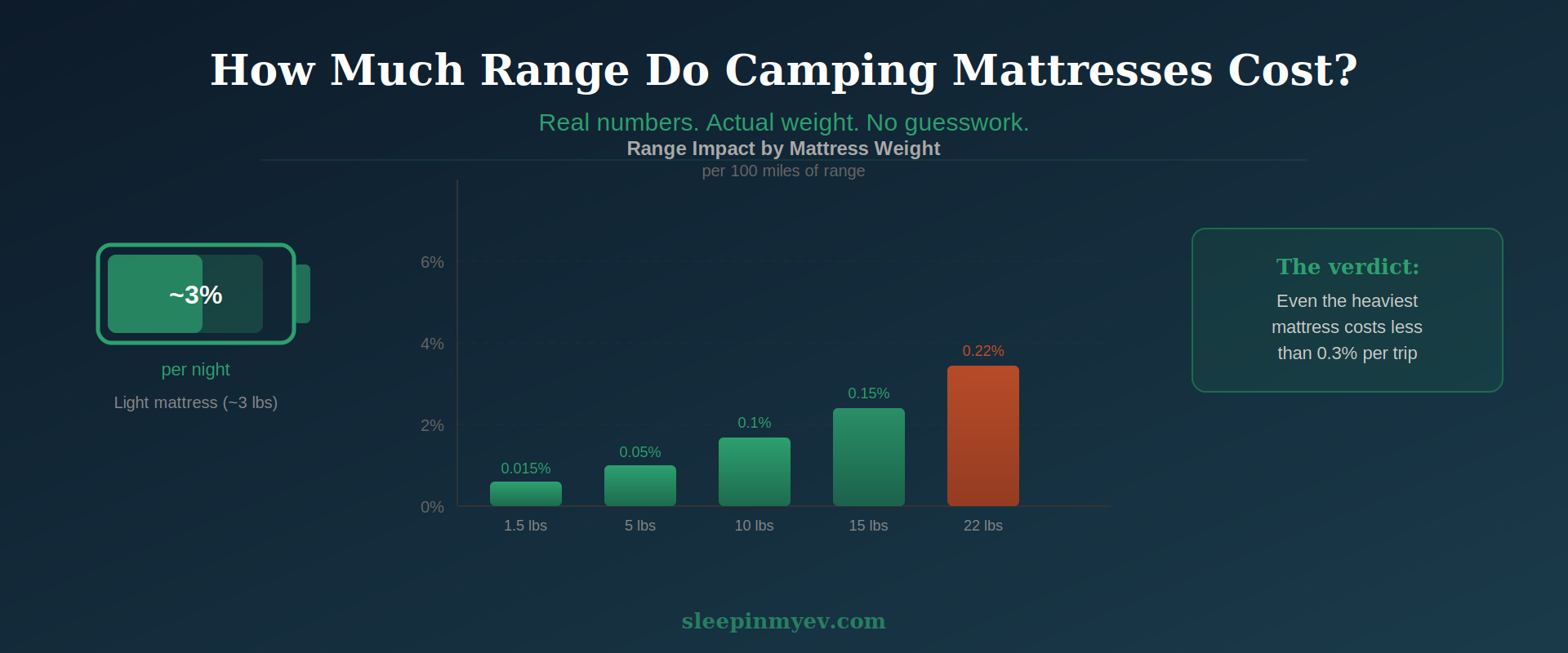
You're shopping for a camping mattress. You find a 25-pounder you love. Then you wonder: "How much range will this kill?" The internet gives you wildly different answers. We went to the data — here's the honest answer.
The Formula: Industry Standard
The established benchmark in EV efficiency is straightforward: every 100 pounds of additional weight reduces range by approximately 1%. This comes from EPA testing, Tesla's own published data, and thousands of real-world EV owner measurements. It accounts for rolling resistance and the minor aerodynamic effect of cargo inside the vehicle.
Example: 25 lb mattress → 25 ÷ 100 = 0.25% range loss
That's it. No complex physics — just a reliable rule of thumb backed by real-world data.
Real Mattress, Real Numbers
Let's put a 25 lb self-inflating mattress — a common mid-range weight — into a Tesla Model Y with 260 miles of EPA-rated range:
That's less range than you'd lose by driving one extra block to a different campsite entrance. It's real, but it's not consequential for most trips.
Your Full Camping Setup — The Real Picture
A mattress alone isn't what you should be tracking. Here's what a realistic full camping setup costs across a 260-mile EV:
| Item | Weight | % Loss | Miles Lost |
|---|---|---|---|
| 20 lb mattress | 20 lbs | 0.20% | ~0.5 mi |
| Roof box | 40 lbs | 0.40% | ~1.0 mi |
| Other gear (clothes, cooking, etc.) | 60 lbs | 0.60% | ~1.6 mi |
| Total setup | 120 lbs | 1.20% | ~3.1 mi |
Your complete camping setup costs around 3 miles of range. Not 30. Not 60. Three.
What Actually Kills Your Range (Ranked)
If you want to make smart decisions about range, here's where the real losses are:
When Does Mattress Weight Actually Matter?
For most EV campers, almost never. But here are the edge cases where it's worth thinking about:
| Scenario | Does weight matter? | Why |
|---|---|---|
| Weekend camping, 150 mi round trip | No | Well within any EV's range buffer |
| Road trip with mid-trip charging | No | You're already charging; 0.3% is irrelevant |
| Pushing range limits (230+ mi single charge) | Maybe | Every mile matters when you're close to the edge |
| Combined with roof box on long highway trip | Worth considering | Aero + weight adds up; lighter helps at the margin |
| Winter camping, cold battery | Indirectly | Higher R-value reduces HVAC load overnight |
The Camp Mode Factor — Unique to EV Camping
Here's something traditional campers don't have: climate control running on battery all night. Tesla Camp Mode, Rivian Camp Mode, and VW ID.Buzz electric climate systems maintain a set temperature overnight on battery — safely, quietly, with no engine running.
This fundamentally changes which mattress you need:
| Camping type | R-value needed | Why |
|---|---|---|
| Traditional tent (no heat source) | R-4 to R-5 | Mattress must insulate you from cold ground |
| EV camping with Camp Mode | R-1.5 to R-3 | HVAC maintains temperature; mattress just needs to be comfortable |
A lighter, lower R-value mattress with Camp Mode often delivers a warmer, more comfortable night than a heavy R-8 pad in a traditional tent. You're choosing for comfort and fit — not insulation.
The exception: high R-value mattresses actually save battery when Camp Mode is running. If your HVAC has to work less because your mattress insulates well, overnight battery drain is lower. For cold-weather EV camping, a mattress like the Luno AIR+FOAM Pro (R-11.2) or Exped MegaMat Duo (R-8.1) is a genuine efficiency tool, not just a comfort upgrade.
Mattress Recommendations by Range Priority
| Priority | Best pick | Weight | Range impact |
|---|---|---|---|
| Minimum range impact | NEMO Quasar 3D Insulated | 3.6 lbs | 0.036% |
| Lightweight + comfort balance | Sea to Summit Comfort Deluxe LW | 5.2 lbs | 0.052% |
| Best overall for solo EV campers | Therm-a-Rest MondoKing 3D | 5.5 lbs | 0.055% |
| Best overall for couples | NEMO Roamer Double | 7.5 lbs | 0.075% |
| Premium comfort, high insulation | Exped MegaMat Duo 10 | 9.9 lbs | 0.099% |
The Bottom Line
A 25 lb camping mattress costs you approximately 0.65 miles of range on a 260-mile EV.
Your roof box, your driving speed, and cold weather each matter 50–200× more than your mattress weight. Pick the mattress that fits your EV, feels comfortable, and suits your budget. Plan charging stops based on trip distance — not mattress weight.
Find the Right Mattress for Your EV
Use our comparison tool to filter by your specific vehicle — it shows which mattresses are rated Good, Fair, or Poor for the actual floor dimensions of each EV, with specs, prices, and our EV-specific notes.